A Japanese atomic bomb?

International experts agree: Japan has the technical capabilities and expertise to produce a nuclear device within three years. What was once only a possibility became a reality when a member of Sanae Takaichi’s entourage expressed the desire for Japan to possess a nuclear deterrent. This statement should have caused an uproar, as almost all countries in the world have signed the NPT treaty, which prohibits the emergence of new nuclear states. However, this statement did not elicit any notable reaction: in Europe, there was silence; in the United States, a look away; and only China expressed an opportunistic condemnation. If the manufacture of a Japanese bomb were to be confirmed—the debate on this point remains open—it would mean the emergence of a new nuclear power, and thus a further undermining, if not the complete abandonment, of the Nuclear Non-Proliferation Treaty.
FACTS
December 18, 2025: One of the Japanese government’s security advisors states that he hopes Japan will acquire its own nuclear weapons.
ISSUES
For Sanae Takaichi, the hope that Japan might one day join the ranks of nuclear powers
FORWARD-LOOKING COMMENTS
In December 2023, the article East of the New in La Lettre d’Asie211 warned that Japan, possessing sufficient quantities of plutonium and enriched uranium, also had the necessary know-how to manufacture bombs and could quickly assemble devices if it had not already done so. These remarks are now reinforced by statements from an aide to Prime Minister Sanae Takaichi, expressing the hope that Japan would cross the nuclear threshold.
The Announcement and the Denial
On December 18, 2025, an advisor to the Japanese Prime Minister stated that the country should possess nuclear weapons, citing the nuclear buildup among its neighbors, the Russian threat, and the uncertain reliability of American deterrence.
The international press reported on the vehement condemnation of this statement by China and North Korea. Yet, week after week, the prospect of a Japanese atomic bomb leaves Western governments indifferent.
By convincing her people that surrounding nuclear threats justify such a move, relying on her parliamentary majority, and taking advantage of Western laissez-faire, Sanae Takaichi could hope to turn Japan into a nuclear power.
If this happens, what is currently only a possibility would become reality.
The announcement came as a surprise and was perceived by some as inappropriate or incongruous. Defense Minister Koizumi and Foreign Minister Motegi denied it. The Prime Minister’s Chief Cabinet Secretary, Minoru Kihara, told the press that Japan “adheres to the three principles of nuclear non-proliferation2” and that it “will continue to work toward a world without nuclear weapons.”
The national debate over the possession of nuclear weapons remains a recurring issue. According to a survey conducted by the Japanese Red Cross in 2025, the majority believed that nuclear weapons should neither be possessed nor used, although 32% of teenagers considered their possession inevitable. The Japanese right-wing press does not condemn the proposal, and in an editorial, the Sankei Shimbun argues that in the face of growing threats from neighboring countries, no option to protect the population should be ruled out.
A bomb within three years
Global experts agree that Japan would have no major difficulty designing and assembling a fission bomb.
In 2014, Japan had 9 tons of plutonium, enough to manufacture hundreds of bombs. It can also produce weapons based on highly enriched uranium by drawing on the expertise of the Japan Nuclear Fuel Limited group (see Box 1). The country possesses missile and precision engineering capabilities to design a basic warhead and integrate it into an existing or yet-to-be-designed delivery system. It is considered a “latent nuclear power,” capable of rapidly equipping itself—in less than three years—to design a warhead and integrate it into a delivery system3.
The South China Morning Post reports that Chinese nuclear experts believe Japan possesses both the political motivation and the technical capability to develop nuclear weapons in less than three years. This warning echoes that of Henry Kissinger, who, in 2023, stated that Japan aspired to regain its pre-war military status when the opportunity arose, and that it could become a nuclear power within five years.4
Despite Japan’s official commitment to the three non-nuclear principles, it is suggested that, in secret, the country has begun studies, gathered expertise, and developed an industrial infrastructure to manufacture a bomb, much like France did in the 1950s under the Fourth Republic, despite strong political opposition. In 1960, the law establishing a nuclear deterrent force was adopted under Article 49, Paragraph 3.
Skeptical observers will see the November 2025 announcement of an anti-espionage law as a sign of Japan’s nuclear intentions.5
Hide this device from our sight
Given Japan’s signature on the Treaty on the Prohibition of Nuclear Weapons, the announcement of the project should have caused an outcry and raised the possibility of sanctions.
§ The West remains unmoved. In Europe, there is silence. On the American side, heads are turned away. A spokesperson for the U.S. State Department simply told the Japan Times: “Japan is a global leader and a valuable partner of the United States on nuclear non-proliferation.” This lack of condemnation is widely reported by the Japanese media.
§ China, which is not overly concerned about the possibility of a Japanese bomb, is observing and analyzing the situation while using the event for foreign policy purposes. Beijing views the statement by a senior Japanese official involved in national security as a “calculated trial balloon” to test global tolerance and calls for an international response6.
§ If North Korea expresses its outrage, it is because Japan’s nuclear ambitions indirectly legitimize its own arsenals. But this indignation masks the fact that this project benefits the DPRK as much as it does Iran, which is subject to severe sanctions, while India, Pakistan, and Israel are not sanctioned. Article II of the treaty is not applied uniformly by the international community, which interprets it based on a country’s perceived respectability or alliances.
This could spell the end of the Nuclear Non-Proliferation Treaty
Will the Japanese government be able to convince its people that, in the face of nuclear threats from China and North Korea, it must acquire nuclear weapons? Will it succeed in having the legitimacy of such an ambition recognized and in being accepted as a nuclear power? This would call into question, or even undermine, the Nuclear Non-Proliferation Treaty.
Edouard Valensi, Asie21
(1) See Asie21 No. 178/2023-12 South Korea – Japan – United States: East of the New
(2) Statement by Prime Minister Eisaku Sato before the House of Representatives Budget Committee (December 11, 1967): “My responsibility is to ensure and maintain security in Japan in accordance with the three non-nuclear principles of non-possession, non-production, and prohibition of the introduction of nuclear weapons, in accordance with Japan’s Peace Constitution”
(3) Christopher McFadden, Japan could produce nuclear weapons in three years with current stockpiles, Interesting Engineering, December 28, 2025
(4) Zhang Tong, Chinese nuclear experts believe Japan could build nuclear weapons in less than 3 years, South China Morning Post, December 27, 2025
(5) Honourway Asia Pacific Limited, Takaichi to Begin Consideration of Anti-Spy Law Within the Year, World Insight, 11/27/2025
(6) Meng Zhe, Xu-Pan Yiru, and Gao Jie, Japan's nuclear daydream must be stopped, China Daily, 12/22/2025
Box 1
The Uranium Enrichment Cycle
If Japan decided to acquire a nuclear weapon, obtaining fissile materials would not pose a major difficulty.
§ The country has an extensive and powerful nuclear industrial base, capable of discreetly housing facilities for the manufacture of nuclear warheads. The country possesses plutonium by the ton.
§ It possesses several tons of plutonium.
§ The production of highly enriched uranium would not be a critical obstacle, thanks to the significant industrial infrastructure of Japan Nuclear Fuel Limited*.
The Rokkasho enrichment facility has sold 1,700 tons of uranium enriched to 3–5% since it began operations in the 1990s.
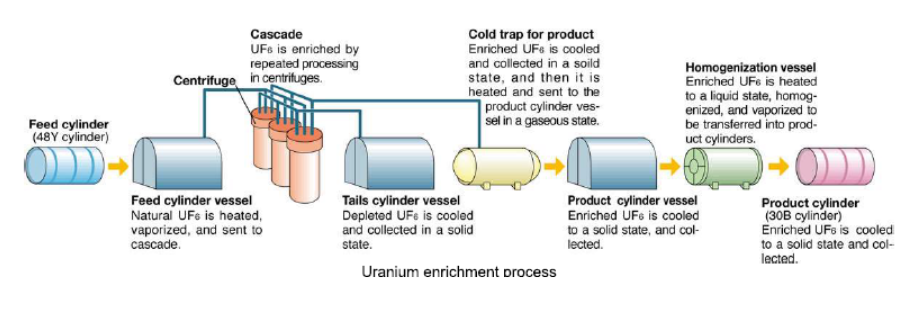
Particular attention must be paid to the heart of the facility: the centrifuge cascade. Since the 2010s, it has consisted of centrifuges utilizing architectures and technologies specific to JNFL.

In addition to the unique cycle followed by gaseous uranium—again, according to JNFL—the use of a composite material instead of metal for the rotor body gives the basic centrifuge models separation performance levels 4 to 5 times higher than those of conventional centrifuges with metal bodies.
Edouard Valensi Asie21


